

 Cultures & Publics
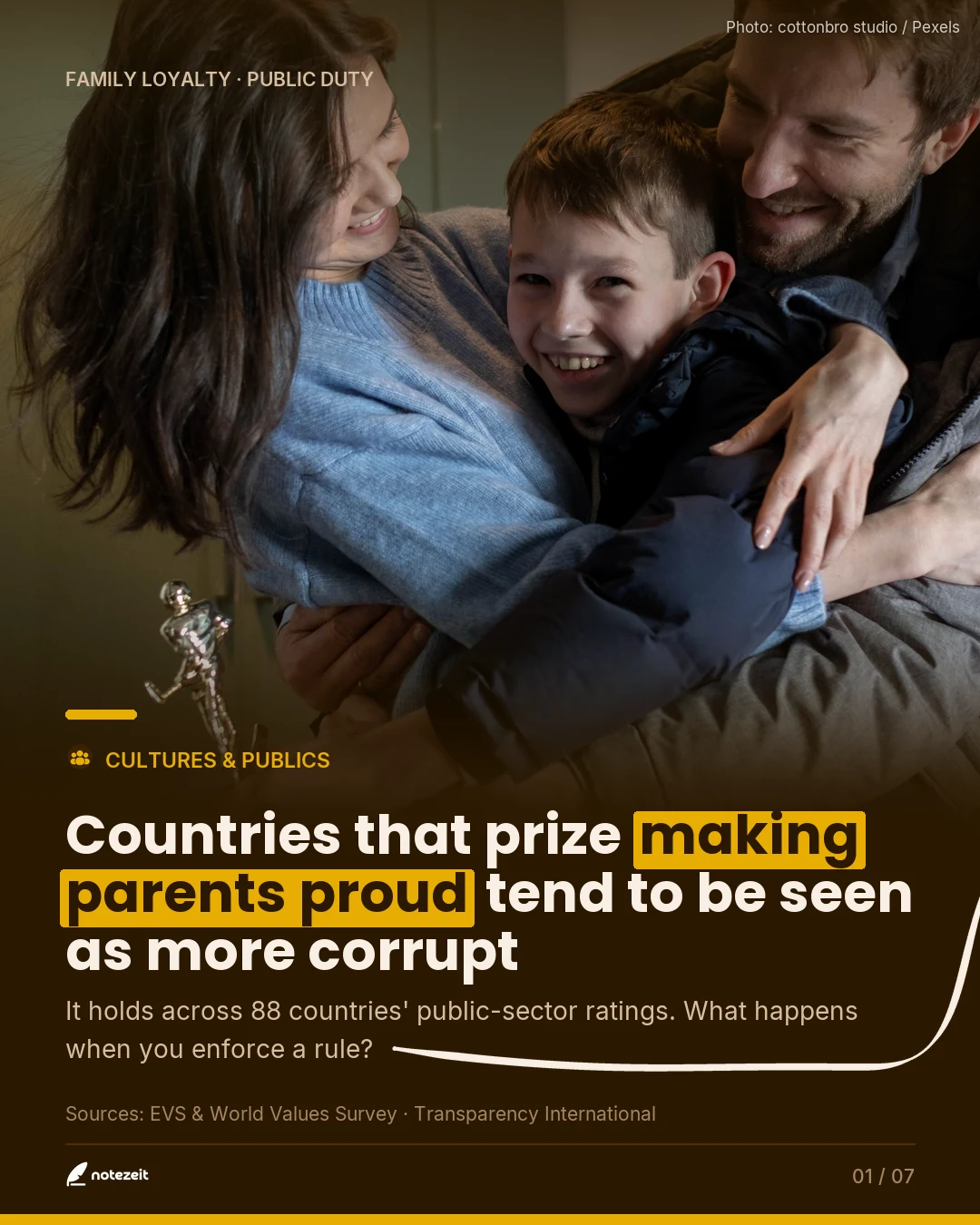
Countries that prize making parents proud tend to be seen as more corrupt
It holds across 88 countries' public-sector ratings. What happens when you enforce a rule?
The carousel
All 7 cards as they were posted. Scroll sideways to read them in order.
The caption
Where more people live to make their parents proud, the public sector tends to be rated more corrupt.
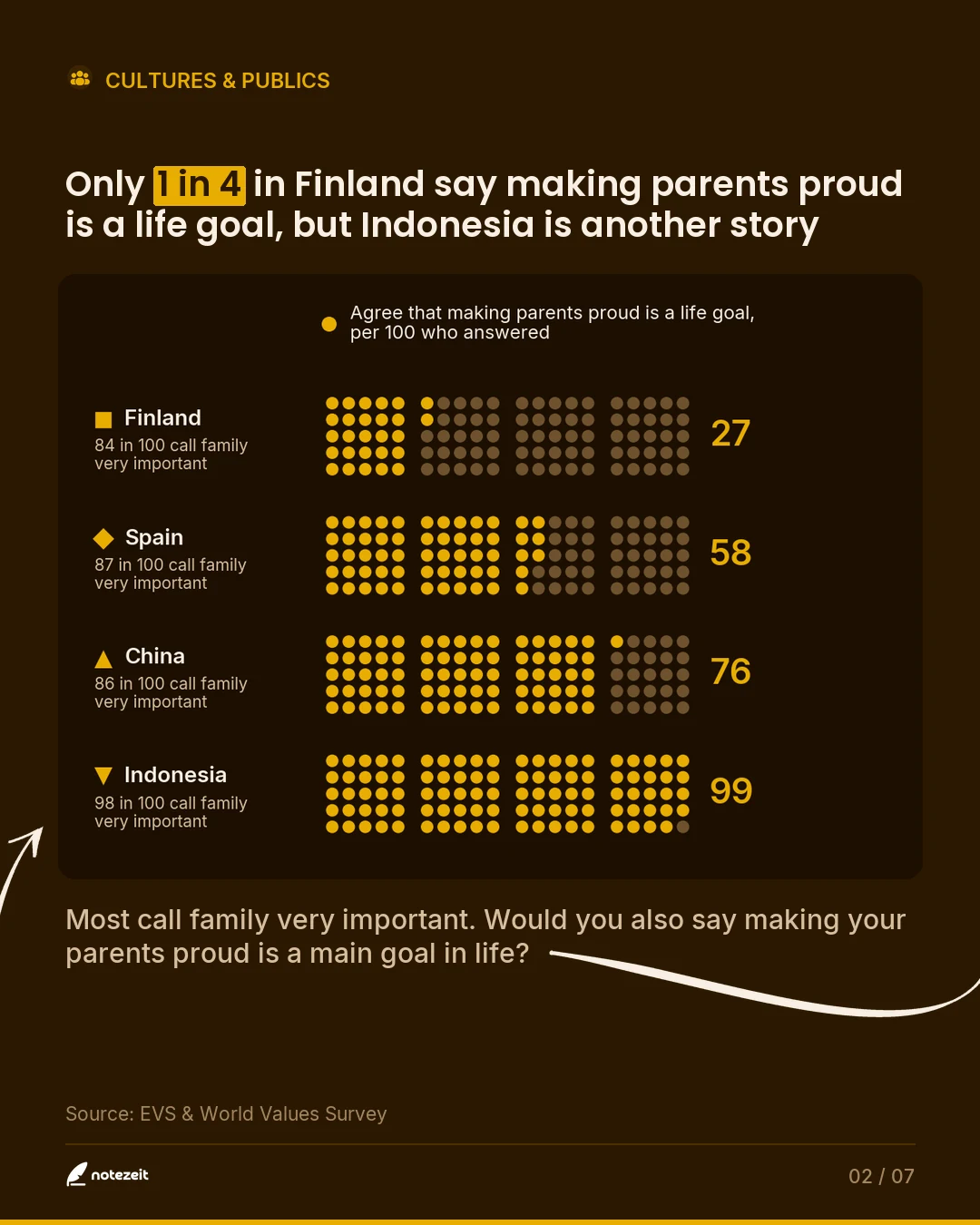
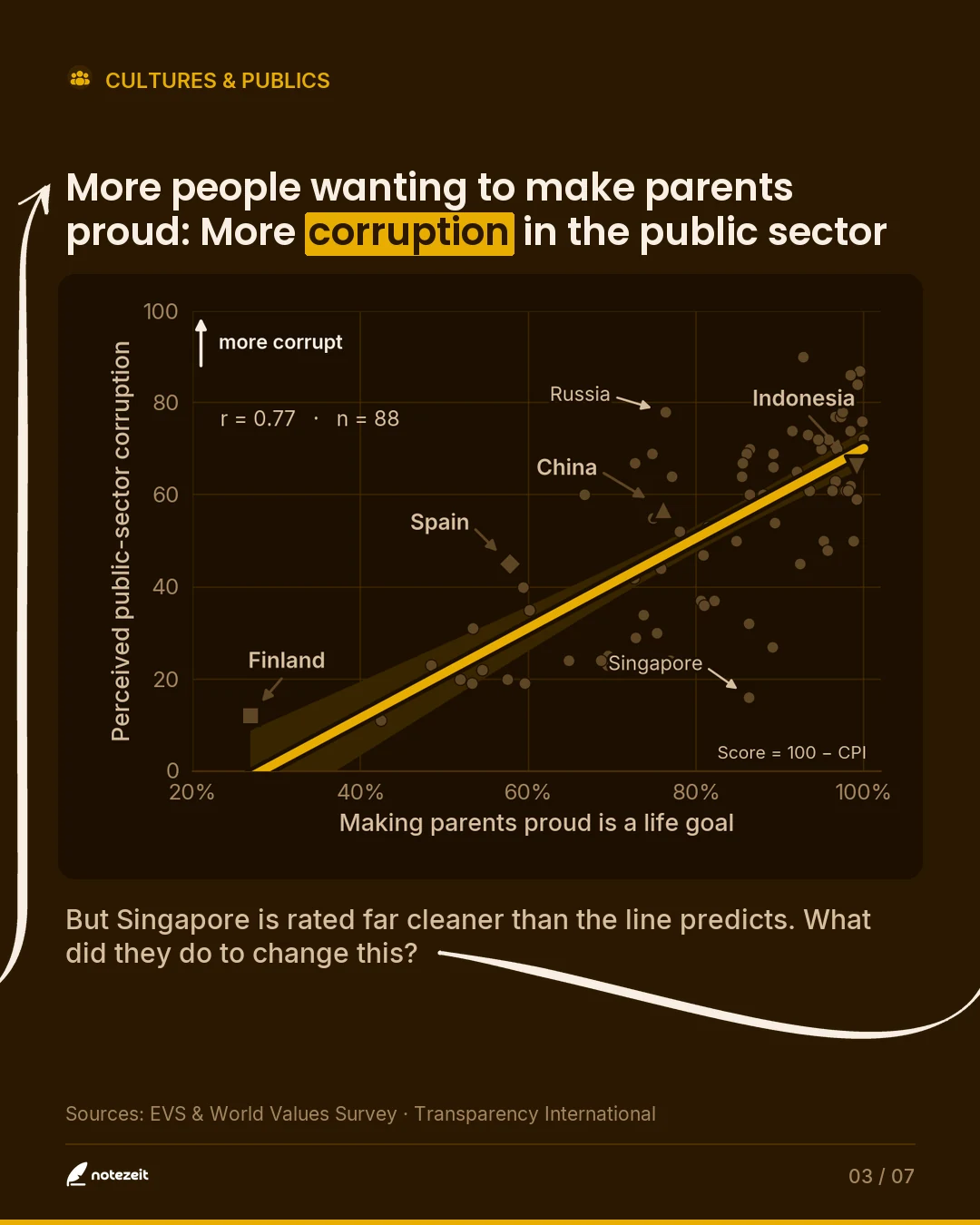
Is making your parents proud one of your main goals in life? In Finland about 1 in 4 say yes; in Indonesia, nearly everyone. Across 88 countries, the more people say yes, the more corrupt the public sector is seen; Singapore and Russia stray furthest from the line.
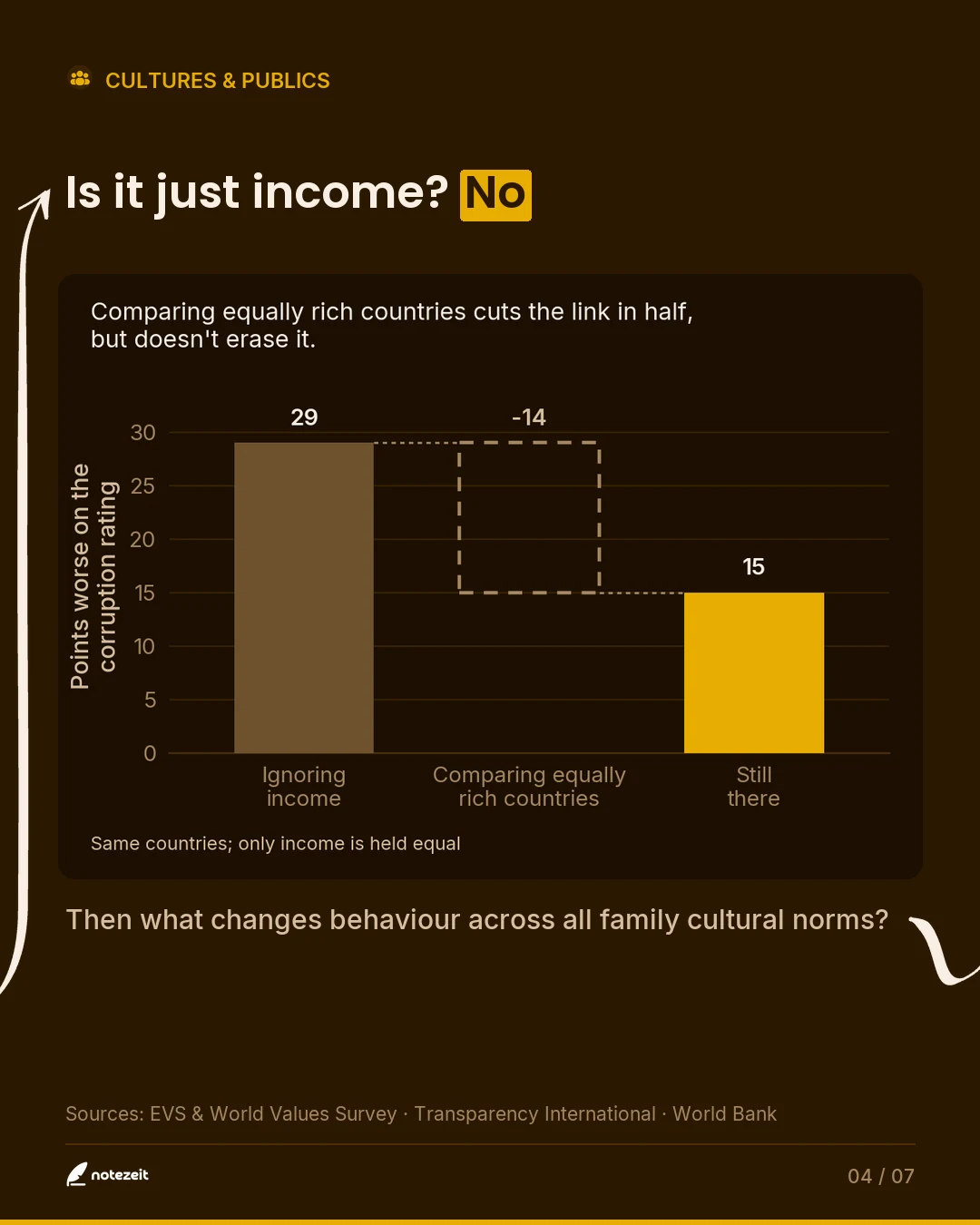
Is it just money? It doesn't seem like it: After comparing equally rich countries, the correlation is still there.
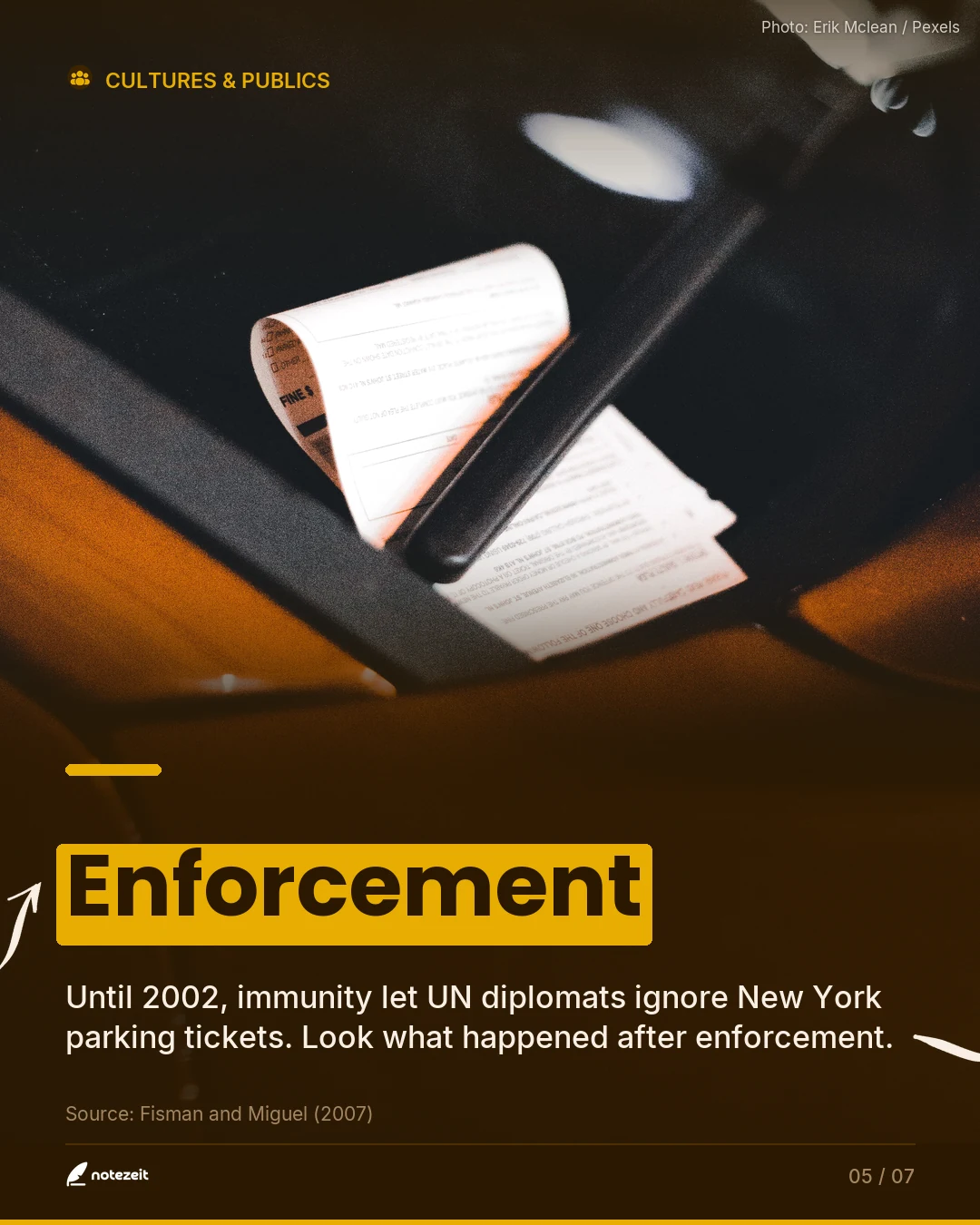
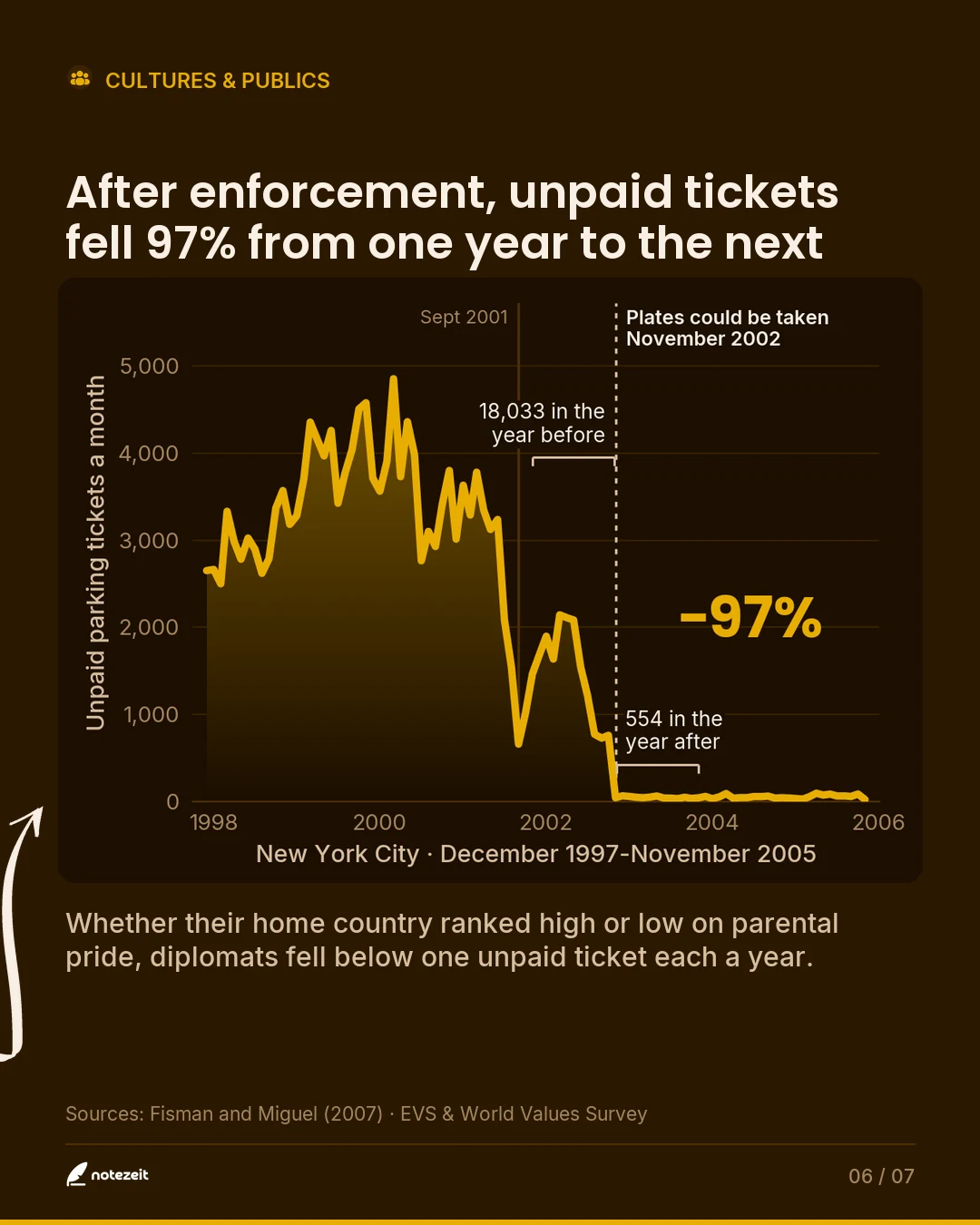
What does enforcement do? Until 2002, immunity let UN diplomats ignore New York parking tickets. Once plates could be taken, unpaid tickets fell 97% from one year to the next. Matched by country, those from places with the most parental pride had left about nine times as many unpaid per diplomat as the least; afterwards every group fell below one a year and the gap shrank to about three times.
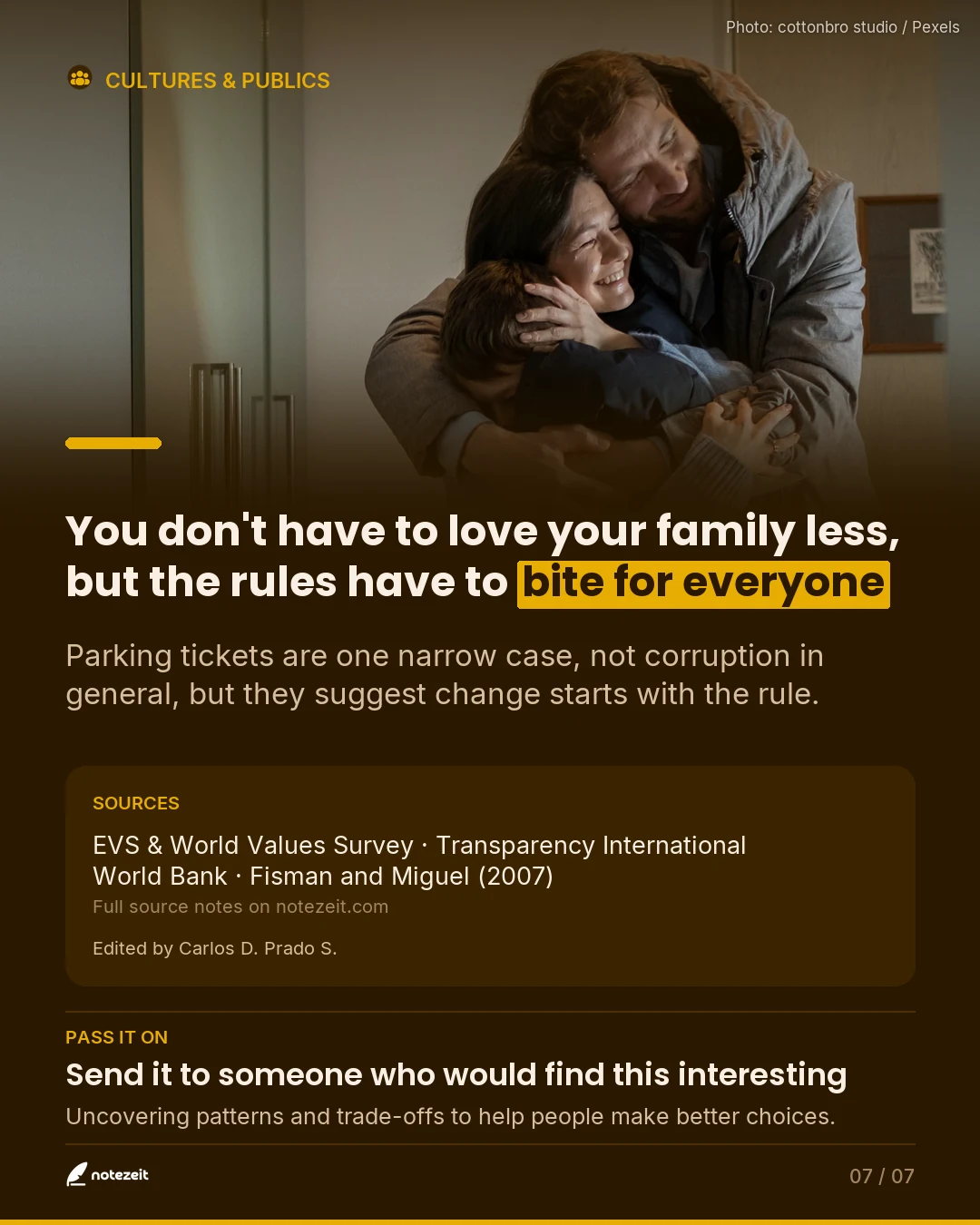
So, you don't have to love your family less, but the rules have to bite for everyone.
Photos: cottonbro studio on Pexels; Erik Mclean on Pexels.
What each card says, and where it comes from
Every card of the carousel, in order, with the sources behind it.
- 01
Cover
Countries that prize making parents proud tend to be seen as more corrupt
From EVS & World Values Survey · Transparency International
Photo: cottonbro studio on Pexels (Pexels License).
- 02
WOULD YOU SAY YES?
Only 1 in 4 in Finland say making parents proud is a life goal, but Indonesia is another story
- 03
DOES IT LINE UP WITH CORRUPTION?
More people wanting to make parents proud: More corruption in the public sector
- 04
ISN'T THAT JUST MONEY?
Is it just income? No
From EVS & World Values Survey · Transparency International · World Bank
- 05
SO WHAT LOWERS IT?
Enforcement
Photo: Erik Mclean on Pexels (Pexels License).
- 06
WHAT DID THE DIPLOMATS DO?
After enforcement, unpaid tickets fell 97% from one year to the next
- 07
SO WHAT SHOULD CHANGE?
You don't have to love your family less, but the rules have to bite for everyone
Photo: cottonbro studio on Pexels (Pexels License).
Sources
For each source, what it supports in this story and what it cannot tell us.
FC01
EVS & World Values Survey — country crosstabs 2017-2022
- What it supports
- Family importance, parents-proud agreement, bribe attitudes; exact 2026-08-06 cached tables.
- What it cannot tell us
- Online heading says Wave 7, but includes EVS and 92 territories; see FC10 and analysis.md. Substantive-answer denominator.
Read on 5 November 2026
FC02
Transparency International Corruption Perceptions Index 2025
- What it supports
- Country-level perceived public-sector corruption outcome.
- What it cannot tell us
- Widely used index; perception-based, not direct observed corruption.
Read on 5 November 2026
A02
Offline rebuilt family analysis and pinned-source extractor
- What it supports
- Source/denominator audit; country distributions and scatter labels by rule, CPI slopes and their 6-in-10 to 9-in-10 restatement, bribe attitudes, actual monthly parking records and equal twelve-month comparison, reproduction of FC09's published results, diplomat thirds, and one declared pride/tickets test.
- What it cannot tell us
- Exploratory; committed extracts with SHA-256 provenance; human review remains pending.
Read on 5 November 2026
FC10
EVS & World Values Survey — joint 2017-2022 documentation
- What it supports
- Combined 92-country/territory coverage versus 66 for WVS alone; survey dates and common items.
- What it cannot tell us
- Primary documentation; exact version of the archived online tables is not established.
Read on 5 November 2026
FC03
World Bank via Our World in Data — GDP per capita
- What it supports
- Income sensitivity check.
- What it cannot tell us
- Reputable aggregator; GDP is only a crude confounder.
Read on 5 November 2026
FC09
Fisman and Miguel 2007, "Corruption, Norms, and Legal Enforcement"
- What it supports
- Norms and enforcement both matter.
- What it cannot tell us
- Peer-reviewed revealed-behavior study; not a family-loyalty measure.
Read on 5 November 2026