

 Bodies & Signals
Which language is more efficient, Spanish or English?
We timed 17 languages reading the same passages to see which gets more across.
The carousel
All 7 cards as they were posted. Scroll sideways to read them in order.
The caption
Spanish is spoken faster than English, so why does English get more across each second?
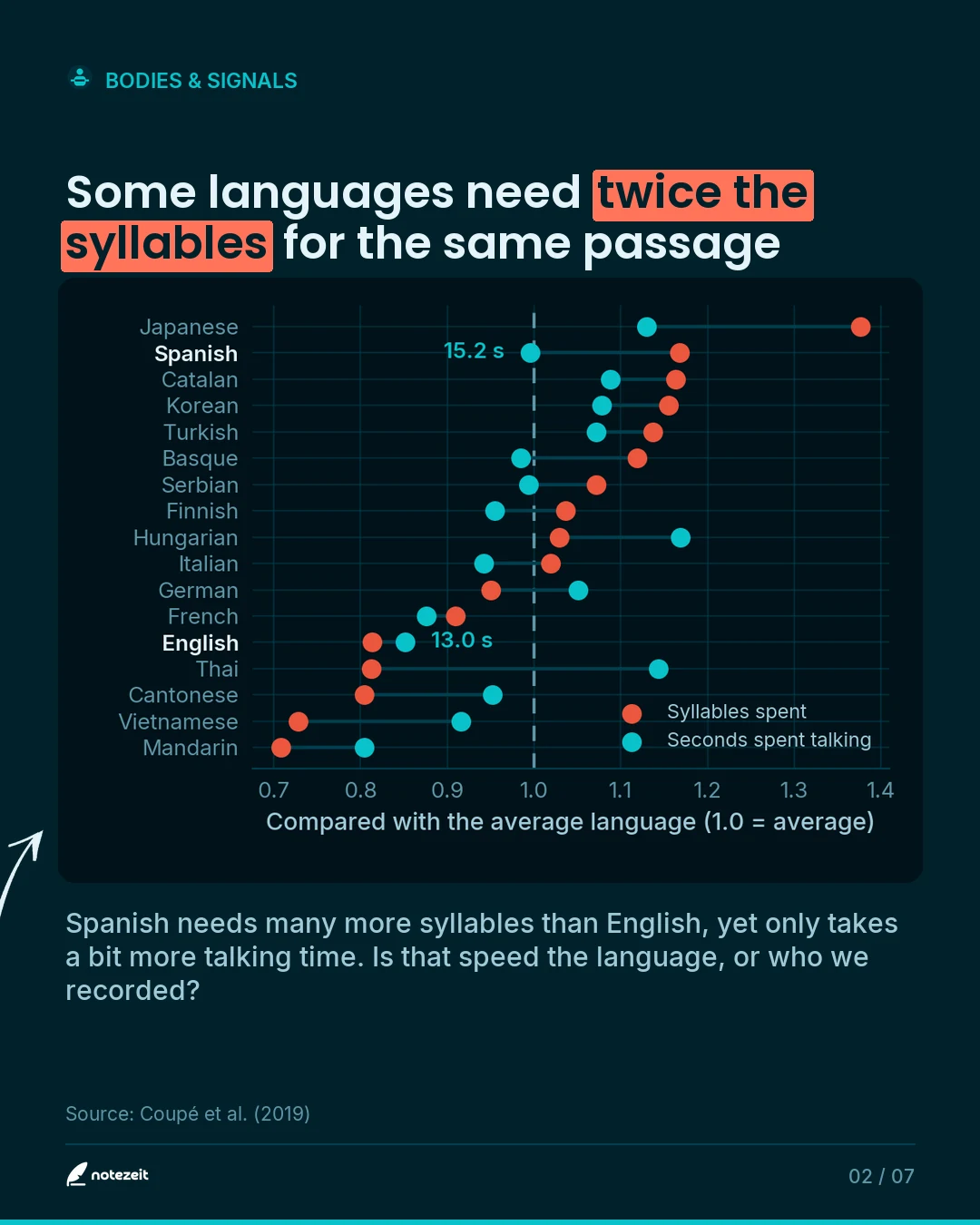
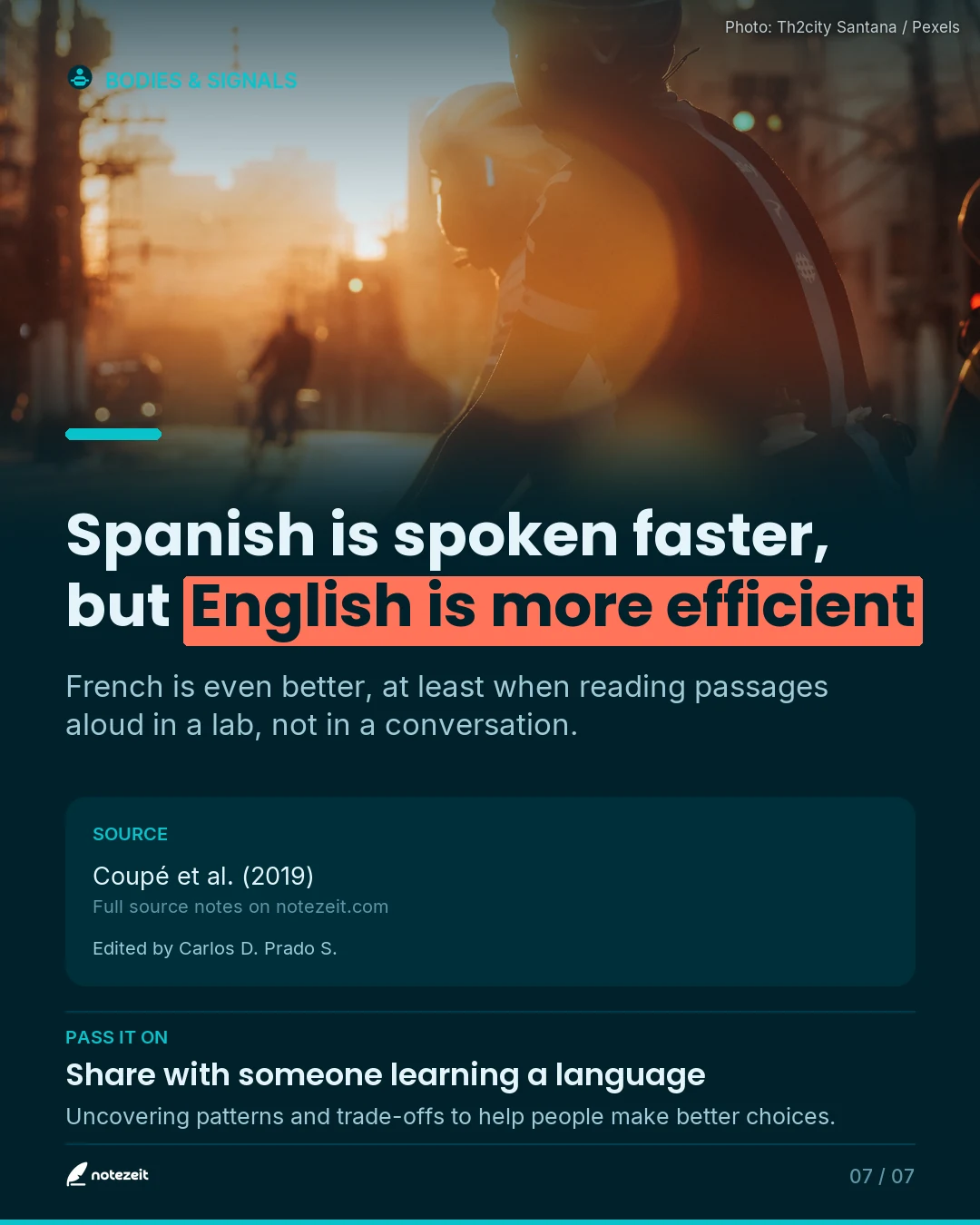
We timed 17 languages reading the same 15 passages aloud, counting only the time spent talking, not the pauses. Spanish fires off more syllables, but each one carries less information, so English gets more across each second: about 45 bits to Spanish's 42. English finished all 15 passages first. It took about 13 seconds to Spanish's 15.
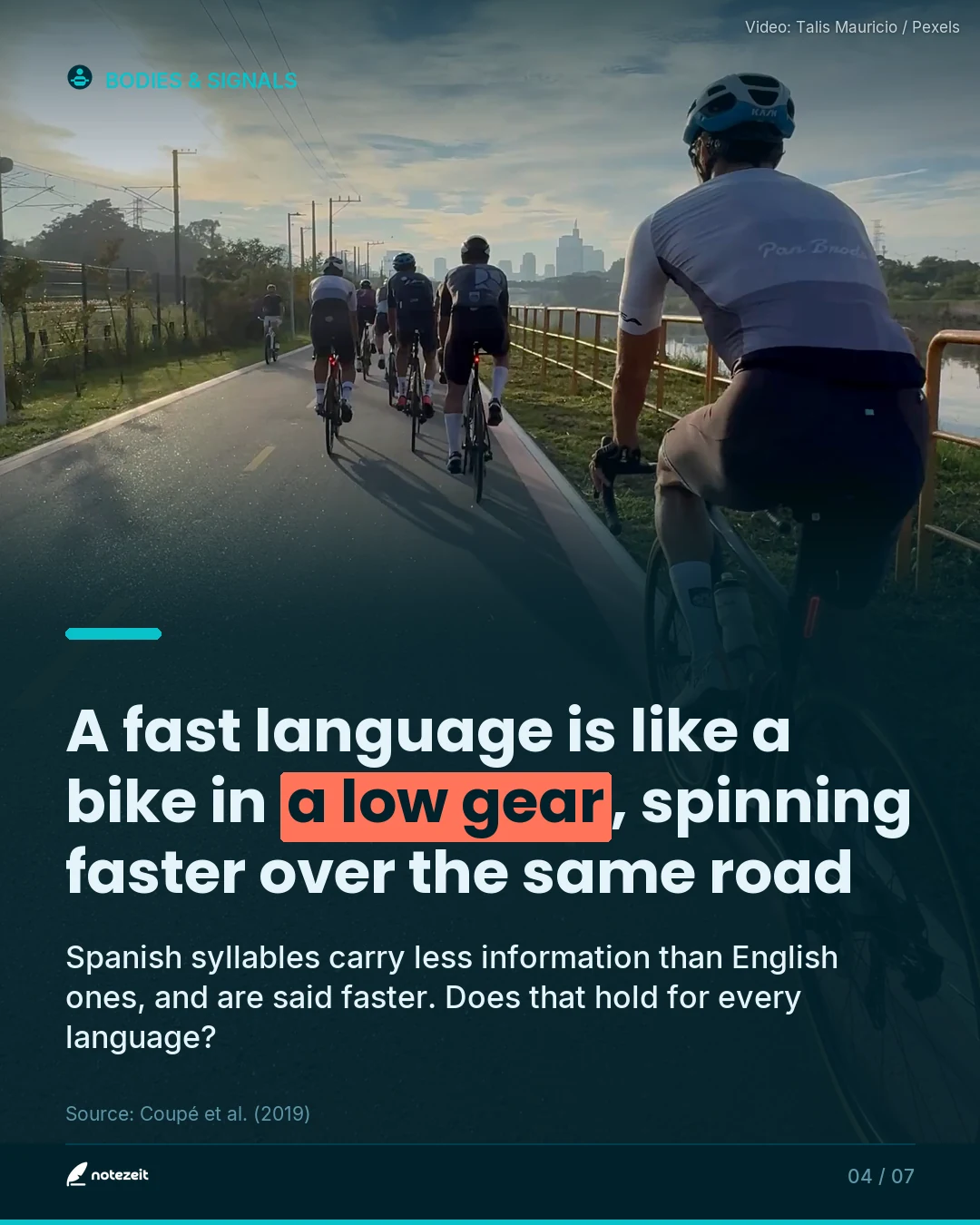
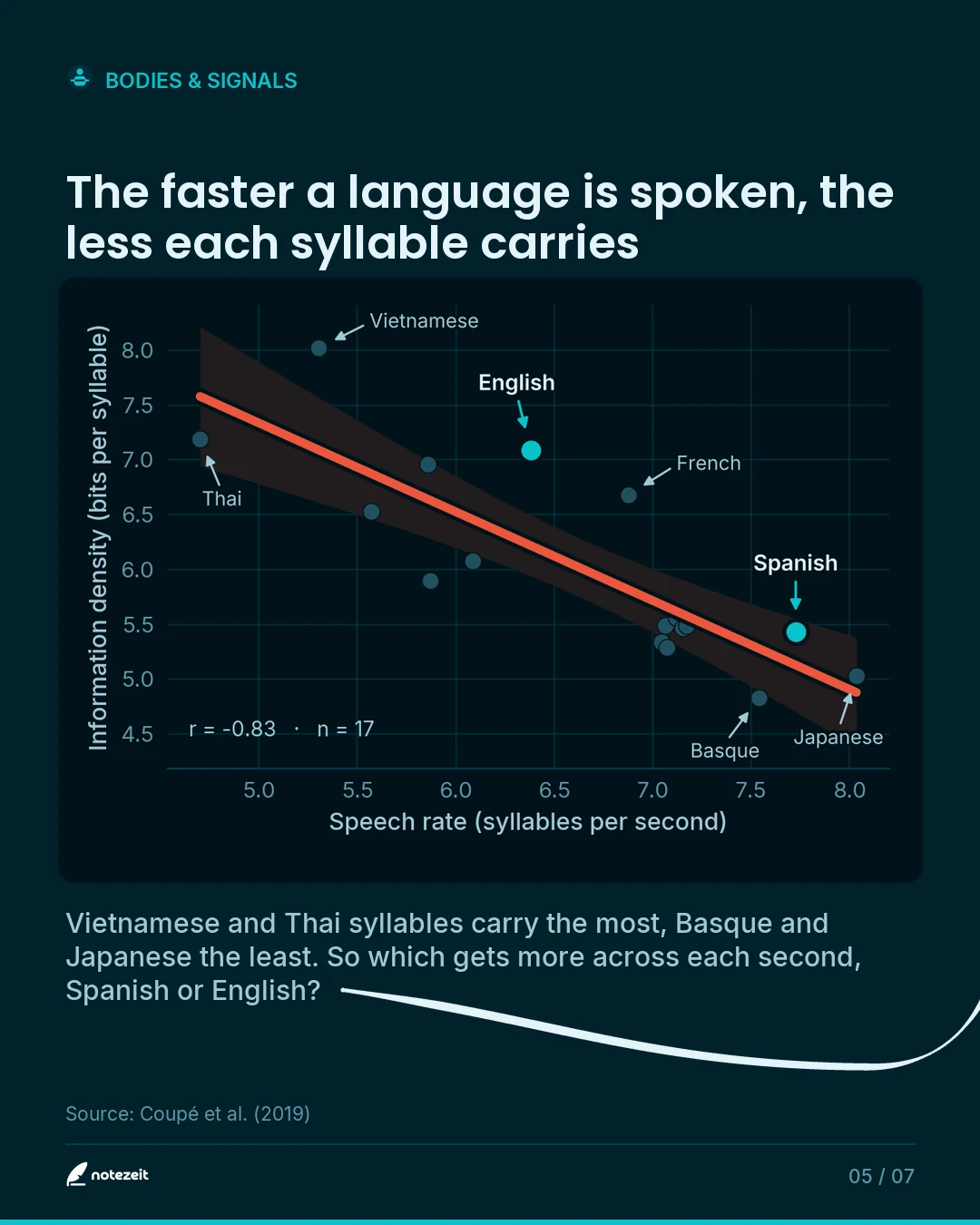
The reason is a trade. A syllable in a fast language carries less information, so the same message takes more of them, said faster. Across all 17, some languages needed twice the syllables of others, but none took twice the time. Multiply speed by what each syllable carries and every language lands between about 34 and 46 bits a second.
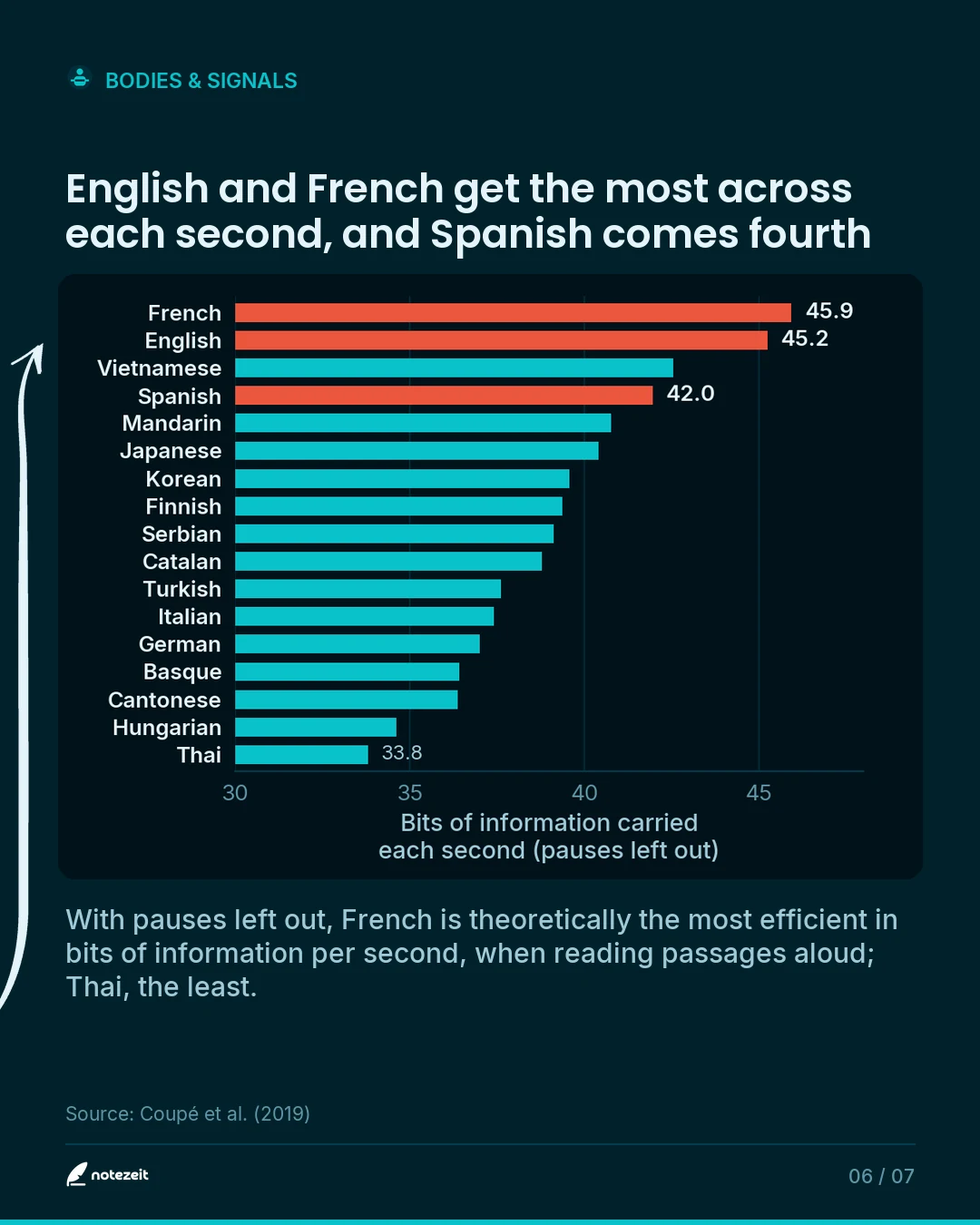
So which language is most efficient? Counting the information carried each second, French and English lead the 17, while Spanish comes fourth, and Thai and Hungarian trail, still getting about three quarters as much across. That ranking comes from rehearsed reading in a lab with the pauses left out, not from conversation, and 12 of the 17 languages are European or close neighbours. "Information" here means how hard each syllable is to predict, not how much meaning it holds, and that estimate has an uncertainty. Mandarin finishes fastest on a stopwatch, because its translated versions use the fewest syllables, but ranks fifth by this count.
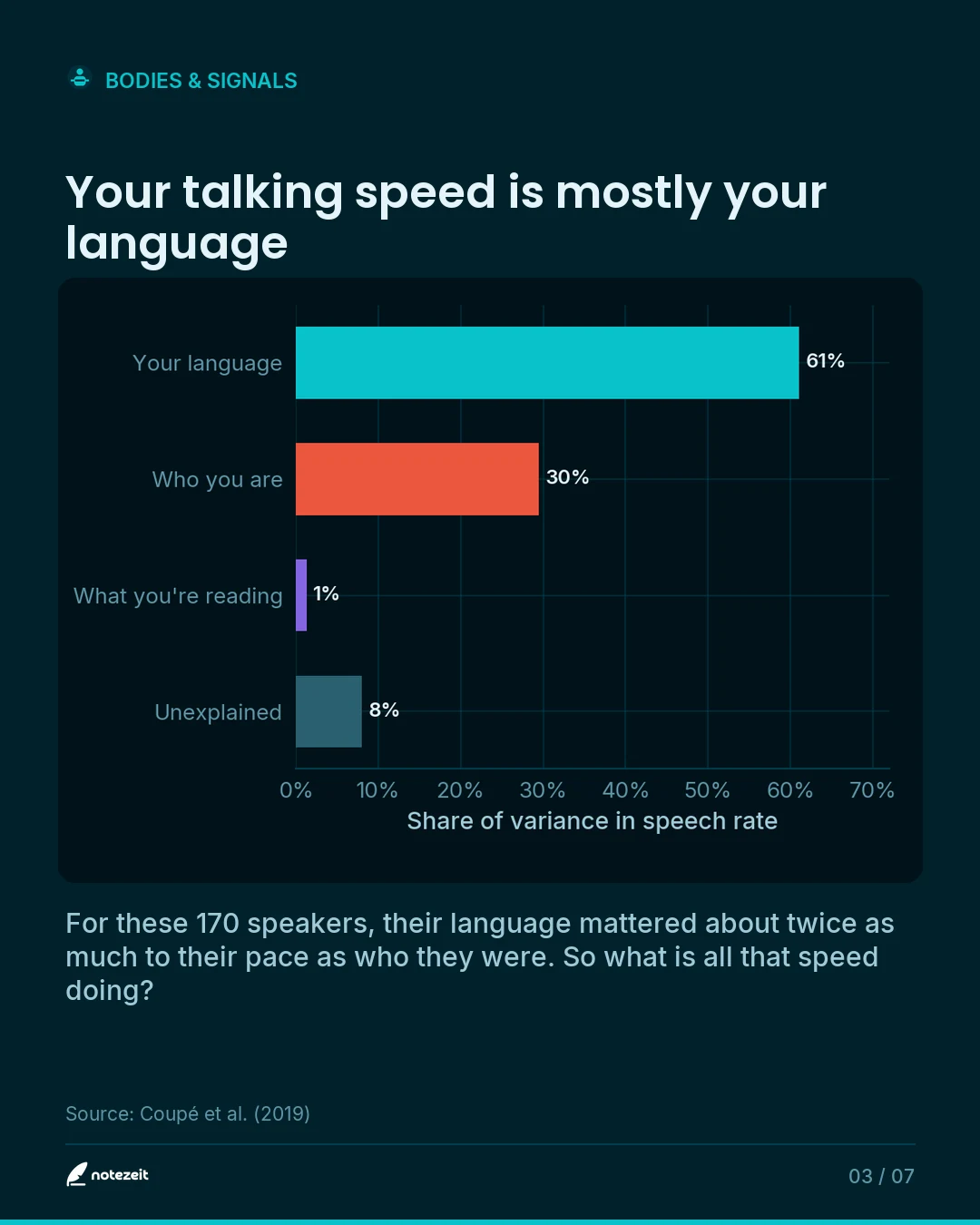
Something we got wrong: we predicted your own pace would matter as much as your language, but it turns out that your language sets most of it.
Data: Coupé, Oh, Dediu & Pellegrino (2019), Science Advances, CC BY-NC.
Photos: Xhemi Photo on Pexels; Th2city Santana on Pexels. Video: Talis Mauricio on Pexels.
What each card says, and where it comes from
Every card of the carousel, in order, with the sources behind it.
- 01
Cover
Which language is more efficient, Spanish or English?
From Coupé et al. (2019)
Photo: Xhemi Photo on Pexels (Pexels License).
- 02
DOES TALKING FASTER HELP?
Some languages need twice the syllables for the same passage
From Coupé et al. (2019)
- 03
- 04
WHAT IS THE SPEED DOING?
A fast language is like a bike in a low gear, spinning faster over the same road
From Coupé et al. (2019)
Video: Talis Mauricio on Pexels (Pexels License).
- 05
DOES IT HOLD FOR ALL 17?
The faster a language is spoken, the less each syllable carries
From Coupé et al. (2019)
- 06
SO WHICH IS MORE EFFICIENT?
English and French get the most across each second, and Spanish comes fourth
From Coupé et al. (2019)
- 07
SO, SPANISH OR ENGLISH?
Spanish is spoken faster, but English is more efficient
From Coupé et al. (2019)
Photo: Th2city Santana on Pexels (Pexels License).
Sources
For each source, what it supports in this story and what it cannot tell us.
LG01
Coupé, Oh, Dediu & Pellegrino (2019), Different languages, similar encoding efficiency: Comparable information rates across the human communicative niche — Data file S1 (per recording) and Data file S2 (pause-inclusive durations)
- What it supports
- Every speech-rate, syllable-count, duration, information-density and information-rate figure in this packet
- What it cannot tell us
- *Science Advances* 5(9):eaaw2594. The primary dataset, re-analysed here from the per-recording rows rather than cited. 2,288 rows, 170 speakers, 17 languages, 15 semantically matched texts, near-fully crossed. Retrieved as supplementary files through the Europe PMC open-access service (PMC6984970). Licence CC BY-NC 4.0 — see the licence note below, it is a live constraint on this packet. Duration is phonation time, pauses excluded, so NS/Duration is articulation rate. ID is one constant per language estimated from written corpora that nobody in the study read
Read on 7 August 2026
LGA01
Local speech-rate and compensation computation
- What it supports
- Every computed number in this packet: the declared family, the variance decomposition, the permutation null, the leave-one-language-out check, the demographic and text models, the WALS ordering, the pause robustness check, the UDHR surface panel and all gates
- What it cannot tell us
- Pearson with Spearman beside it throughout; Holm and BH across the declared family only (H1-H4, H13-H14); variance decomposition by nested random-effects fit and by sum-of-squares, both reported; permutation null at 20,000 draws with a fixed seed. Gates fail the build closed
Read on 7 August 2026